Bulgarian Army
The Reincarnationist PapersThe Bulgarian Army appears in the novel through two sharply different measures of military life: Vasili’s years of service and Captain Hoxa’s celebrated battlefield audacity. Against the Bulgarian front’s retreat in 1918, the army is shown as a force still holding artillery positions even as the wider campaign was collapsing; afterward, Vasili’s return home makes military service one chapter in a life redirected toward family and farming.
Service and Return to Civilian Life
Vasili tells Evan that he served in the Bulgarian Army from 1916 until the armistice was signed in 1918. His account gives that service a clear boundary: after the war, he returned home and worked with his father on the farm for one season. When his father died, Vasili was acquiring land of his own; he built a home on the eighty acres, tended the land and cared for his mother until her death the following year. In 1920, he married. Military service thus leads not to a continuing military identity in the evidence presented, but back to the household and land that shaped his postwar life.
The Retreat and the Artillery Position
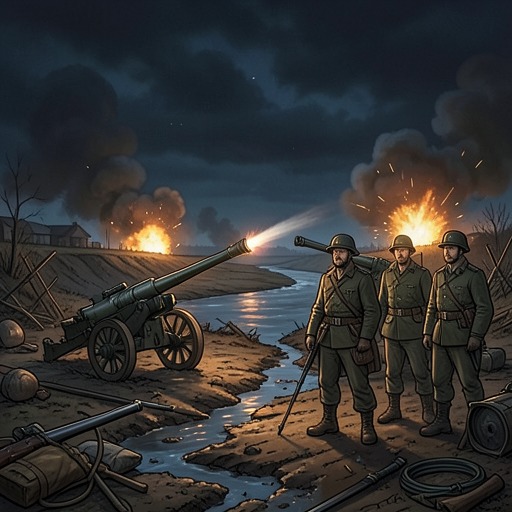
The wartime episode takes place on September 18 and 19, 1918, after the Bulgarian front had been in full retreat for three weeks. The land where the Cherna River joined the Vardar formed a small triangle that Vasili recognized as a poor place to make a stand, even for a single night. He was assigned to the artillery detail, stacking 75-pound, two-foot shells in rows three deep beside the gun emplacement. Five Krupp 77 mm howitzers faced south toward Greece and the French divisions somewhere beyond the horizon. The concrete labor of preparing ammunition and guns sets the exposed position against the retreat unfolding across the front.
Captain Hoxa and Military Reputation
Captain Hoxa’s standing within Bulgaria rests on an earlier feat of initiative. In the first week of the war, he won the Order of Bravery-First Class, Bulgaria’s highest military combat honor, after taking his company out without authorization to outflank a large Rumanian column retreating from Petrila. He moved seventy men and ten artillery pieces thirty miles in a day and night; at first light, his company attacked and captured four generals of the Rumanian High Command. The account presents the maneuver as a tactical masterpiece, but also links Hoxa’s refusal to defer to rear-area commanders with his never rising above captain. His reward for bravery and initiative was a posting at the very front, facing a confident fresh army. Through Hoxa, the Bulgarian Army’s martial reputation is inseparable from the risks borne by its most daring officers.